

From $20 billion to $85 billion by 2030 – discover why spatial computing is exploding right now and how it’s already transforming the way you work, shop, learn, and play.
Look, I’m going to be honest with you – when I first heard the term “spatial computing,” I rolled my eyes so hard I nearly saw my own brain. It sounded like another tech buzzword cooked up in Silicon Valley to make simple things sound complicated.
But here’s the thing: I was completely wrong.
Spatial computing isn’t just another fancy term. It’s the technology that’s making those sci-fi movies you watched as a kid actually come true. You know – the ones where people wave their hands in the air and interact with floating holograms? Yeah, that’s happening. Right now. In 2025.
The market thinks so too. We’re talking about a technology that’s jumping from $20.43 billion in 2025 to a projected $85.56 billion by 2030. That’s not a typo – it’s growing at 33% per year. When was the last time you saw that kind of growth in any industry?
🎯 FUN FACT: The first VR headset was built in 1968 and weighed so much it had to be suspended from the ceiling. Today’s headsets weigh less than a pound and pack more computing power than the Apollo 11 spacecraft that took humans to the moon!
So… What Exactly IS Spatial Computing? (In English, Please)
Alright, let me break this down in a way that actually makes sense.
Imagine your computer could see the room around you. Not just “see” like a camera, but actually understand it – knowing where your couch is, where the walls are, where you’re standing, what you’re looking at.
Now imagine it could put digital stuff – images, videos, 3D models, entire virtual worlds – into that real space. And you could interact with all of it just by moving your hands, walking around, or looking at things.
That’s spatial computing. It’s the merger of the digital world and the physical world, where your environment becomes your interface.
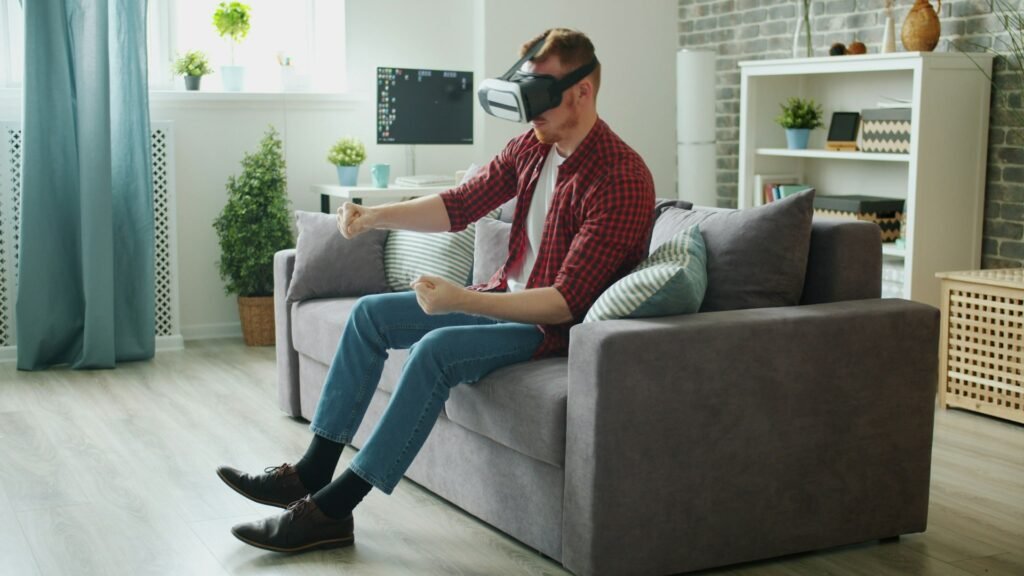
Think about it this way: regular computing confined you to a screen. Spatial computing sets information free to exist anywhere in your space. Your kitchen table can become a virtual chessboard. Your living room wall can display a life-size dinosaur. Your empty garage can become a virtual showroom full of furniture you’re thinking about buying.
It combines three big technologies:
• Augmented Reality (AR) – Digital stuff overlaid on the real world
• Virtual Reality (VR) – Full immersion in digital worlds
• Artificial Intelligence – The brain that makes it all work intelligently
Why Is Everyone Suddenly Obsessed With This?
Good question. Spatial computing has actually been around for years, but 2025 is when everything’s finally clicking into place. Here’s why:
The Hardware Finally Doesn’t Suck
Remember those clunky VR headsets that made you look like you were wearing a microwave on your face? Yeah, those days are over.
Today’s spatial computing devices are sleek. Meta’s Ray-Ban Smart Glasses look like… well, Ray-Bans. You can wear them to a coffee shop without people assuming you’re a cyborg. Apple’s Vision Pro, while pricey, is a marvel of engineering. And companies like XREAL are making AR glasses that cost less than a decent smartphone.
In the first quarter of 2025 alone, global AR/VR headset shipments grew 18.1% year-over-year. Smart glasses exploded by 110% in just six months. People are actually buying this stuff now.
It’s Actually Useful (Not Just Cool)
This is the big one. For years, VR and AR were solutions looking for problems. “Sure, it’s neat, but what am I supposed to do with it?” everyone asked.
Well, now we have answers. Lots of them.
Boeing used VR training to cut training time by 75%. Not 7.5% – seventy-five percent. Delta Airlines saw a 5,000% increase in training throughput. The FAA – the actual Federal Aviation Administration – approved VR-based pilot training that counts toward certification.
These aren’t pilot programs or experiments. Companies are using spatial computing because it saves them millions of dollars and trains people faster and better than traditional methods.
🚁 FUN FACT: Ukraine is using VR flight simulators to train F-16 pilots in the middle of an actual war. The training is so effective that pilots can learn complex maneuvers in a fraction of the time it would take with traditional methods – and nobody gets hurt during the learning process.
Real People Using This Right Now (And How)
Let’s get specific. Here are actual examples of how spatial computing is being used today – not in five years, not “soon,” but right now:
Shopping Without Leaving Your Couch
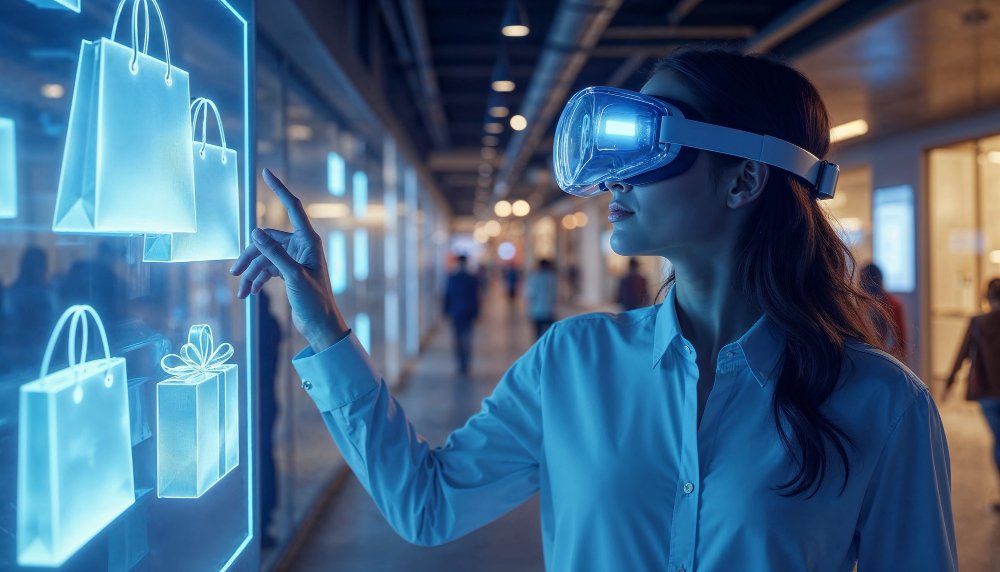
You’re thinking about buying a new couch. Instead of playing mental Tetris trying to imagine if it’ll fit in your living room, you open an AR app on your phone. Boom – there’s a full-size, photorealistic 3D model of the couch in your actual living room.
You can walk around it. Check if it blocks the TV. See if the color really works with your rug. Change the fabric with a tap. Try a different style. All before spending a dime.
IKEA, Wayfair, Amazon – they’re all doing this. And customers love it because it dramatically reduces the “I bought it online and it looks terrible in person” problem.
Medical Training That Saves Lives
Here’s where it gets really cool – and important.
Medical students are practicing surgeries on virtual patients. Not on cadavers. Not on models. On hyper-realistic virtual humans that bleed (virtually), react (virtually), and can die (virtually) if you mess up.
They can practice the same procedure 50 times without needing 50 different training setups. They can make mistakes without consequences. They can see inside the body in ways that aren’t possible with real patients.
Hospitals are using AR during actual surgeries, overlaying patient scans and vital information directly in the surgeon’s field of vision. No need to look away at monitors – all the critical data is right there, floating in front of them.
Education That Actually Engages Students
Pop quiz: What’s more engaging – reading about Ancient Rome in a textbook, or actually walking through a photorealistic reconstruction of the Colosseum while a virtual guide explains how gladiator battles worked?
Yeah, thought so.
30% of universities are now using spatial computing for education. Students are dissecting virtual frogs (sorry, actual frogs), exploring the inside of human cells, walking on the surface of Mars, and traveling back in time to witness historical events.
Teachers report that students retain information better and are way more engaged when learning in VR. Because duh – it’s infinitely more interesting than staring at a textbook.
🎮 FUN FACT: Pokémon GO, which most people think of as “just a game,” is actually one of the most successful demonstrations of spatial computing in history. It has made over $6 billion since launch and proved that people would absolutely use AR in their daily lives – they just needed the right reason.
Manufacturing and Maintenance
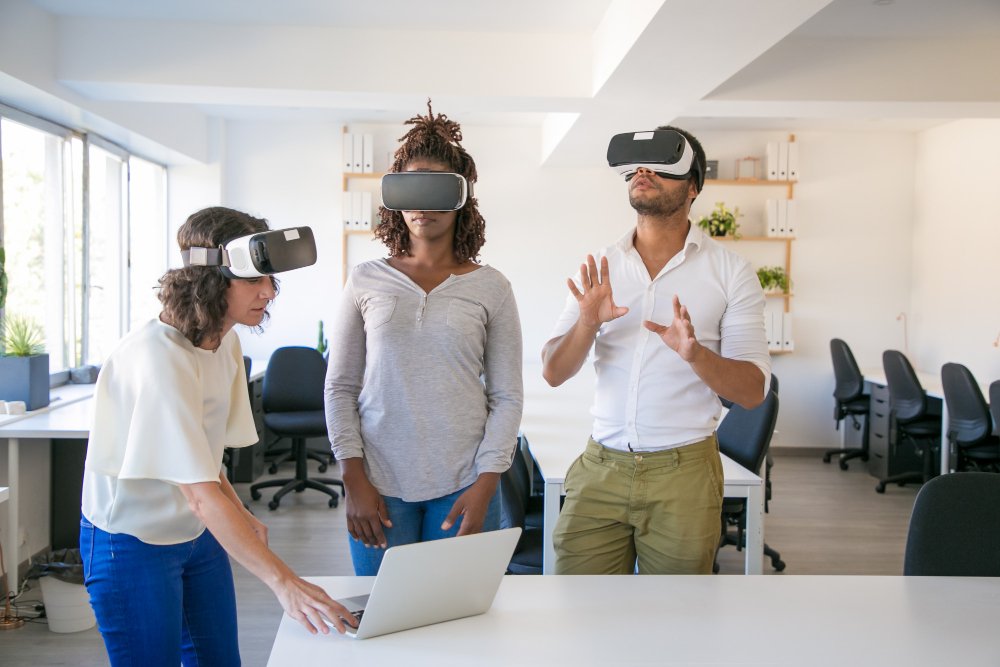
Picture this: You’re a technician fixing a complex piece of machinery you’ve never seen before. Instead of flipping through a 300-page manual, you put on AR glasses and they show you exactly what to do – with arrows pointing to the right parts, step-by-step instructions floating next to your hands, and warnings appearing if you’re about to do something dangerous.
Airbus increased their production efficiency by 25% using AR guidance systems. Boeing, Lockheed Martin, and major automotive companies are all doing this. It’s not experimental – it’s standard operating procedure.
Remote experts can also “teleport” in to help. A specialist in Germany can see exactly what a technician in Brazil is looking at and guide them through complex repairs in real-time.
The Tech That Makes It All Work
Okay, I promised to keep this in English, but let’s geek out for just a minute about how this actually works. Because it’s genuinely impressive.
Spatial Mapping: Teaching Computers to See
Your AR/VR device uses cameras and sensors to create a real-time 3D map of your environment. It’s constantly scanning, measuring distances, identifying surfaces, and tracking movements. It knows where your floor is, where your furniture is, where you are.
This happens dozens of times per second, which is why virtual objects can stay “pinned” to real locations. That virtual TV you placed on your wall? It stays on that wall even if you walk around, leave the room, and come back later.
5G and Edge Computing: Making It Instant
Here’s a problem: rendering photorealistic 3D environments requires massive computing power. You can’t fit a supercomputer in a pair of glasses.
Solution? Do the heavy processing in the cloud and stream the results to your device. With 5G networks and edge computing (where data is processed closer to you rather than in distant data centers), the latency is low enough that you can’t tell the difference.
It’s like Netflix for virtual reality – the content is coming from the cloud, but it feels immediate and responsive.
AI: The Secret Sauce
AI is what makes spatial computing smart instead of just fancy. It handles:
• Object recognition – “That’s a table. That’s a chair. That’s your cat trying to knock things off the table.”
• Gesture recognition – Understanding what your hand movements mean
• Voice commands – Because sometimes you want to just talk to your virtual assistant
• Context awareness – Knowing what you’re trying to do and helping you do it
The AI is constantly learning too. The more you use spatial computing devices, the better they get at understanding you specifically.
👁️ FUN FACT: Modern VR headsets track your eye movements with incredible precision – accurate to within 1.5 degrees. This isn’t just for fancy features – it allows the device to render high-quality graphics only where you’re actually looking, saving huge amounts of processing power.
The Downsides (Because Nothing’s Perfect)
Look, I’m excited about spatial computing, but let’s be real – it’s not all rainbows and holographic unicorns. There are legitimate concerns.
Privacy Issues Are… Yeah
Your spatial computing device is constantly filming your environment, tracking your movements, recording your interactions, and probably knowing more about your home layout than you do.
Who has access to that data? What are companies doing with it? Can it be hacked? These aren’t paranoid questions – they’re legitimate concerns that need solid answers.
Nearly half of developers cite privacy and data security as top legal risks in AR/VR development. They’re worried about it, which means you probably should be too.
The Price of Entry Is Still High
Apple’s Vision Pro costs $3,500. That’s not a typo either. Even more affordable options like Meta Quest 3 will set you back $500-600.
Yeah, there are cheaper options emerging, and prices are dropping every year. But we’re not yet at the point where everyone can afford this stuff. It’s getting there, but we’re not there yet.
The good news? Just like flat-screen TVs, the price will keep falling as the technology matures and production scales up.
Motion Sickness Is Still a Thing
Some people get VR sickness – that queasy, dizzy feeling when your eyes say you’re moving but your body knows you’re standing still. It’s like motion sickness’s digital cousin.
The newer devices are much better about this, with higher refresh rates and better tracking that reduce the disconnect between your movements and what you see. But it’s still an issue for maybe 10-20% of users.
What’s Coming Next (The Really Wild Stuff)
If you think what we have now is cool, buckle up. The next few years are going to get wild.
The Spatial Internet
Imagine walking down the street and seeing digital information overlaid on everything. Point your AR glasses at a restaurant – boom, instant reviews, menu, wait times. Look at a historical building – instant history lesson and virtual tour. See a plant you don’t recognize – instant identification and care instructions.
This isn’t far off. Companies are building the infrastructure for this “spatial internet” right now. Universal Scene Description (USD) is emerging as the standard for 3D content, kind of like HTML is for websites.
Contact Lenses With Displays
Multiple companies are working on AR contact lenses. Yes, actual contact lenses with tiny displays built in.
We’re probably 5-10 years away from these being consumer-ready, but the prototypes exist. Imagine having all the benefits of AR without wearing anything on your face at all.
Full Haptic Feedback
Current VR lets you see and hear virtual worlds. The next generation will let you feel them.
Haptic gloves and suits are in development that can simulate touch, texture, temperature, and even resistance. Touch a virtual object and feel its surface. Shake a virtual hand and feel the grip. Get hit by a virtual dodgeball and feel the impact (safely, don’t worry).
This will be huge for training, entertainment, and remote collaboration. Imagine a virtual team meeting where you can actually fist-bump your colleagues.
🎵 FUN FACT: Virtual concerts are becoming massive business. Companies like Wave are hosting VR concerts where millions of people attend from around the world. The performers are sometimes real musicians in motion capture suits, and sometimes entirely virtual AI-generated artists. Either way, the crowds are real – and they’re paying real money for tickets.
Should You Care About This? (Spoiler: Yes)
Here’s my take: spatial computing isn’t a fad. It’s not going away. It’s the next major computing platform after smartphones.
Think about it – in 2007, the iPhone came out and a lot of people said “Why would I need the internet on my phone? I have a computer at home.” Now try to imagine life without a smartphone.
Spatial computing is in that same early phase. It’s clunky in some ways, expensive, and not quite mainstream yet. But the trajectory is clear.
Within 5-10 years, AR glasses will probably be as common as AirPods. Your kids (or future kids) will think it’s weird that you used to stare down at a flat screen instead of just looking around at digital information in your environment.
For Businesses: You Need to Pay Attention
If you’re running a business, this is mandatory reading: your competitors are already exploring spatial computing. The companies that figure this out early will have massive advantages in:
• Training efficiency (4× faster on average)
• Cost reduction (52% cheaper at scale)
• Customer engagement (way higher with AR shopping)
• Remote collaboration (actually effective finally)
Fortune 500 companies? 75% of them are already running pilots or have spatial computing in production. This isn’t experimental anymore.
For Regular People: It’s Coming to Your Life Soon
Even if you’re not a tech geek or business owner, spatial computing is going to touch your life. You might:
• Shop for furniture using AR in the next year or two
• Attend a virtual concert or sporting event
• Use AR navigation while walking or driving
• Try on clothes virtually before buying
• See your doctor through a virtual appointment that feels surprisingly real
These aren’t maybe-someday possibilities. These are things you can do right now, and they’re only going to get better and more common.
The Bottom Line
Spatial computing is that rare thing in tech: genuinely transformative technology that’s actually delivering on its promises.
Is it perfect? No. Is it for everyone yet? Also no. But is it going to fundamentally change how we interact with digital information and each other? Absolutely yes.
The market growing from $20 billion to $85 billion by 2030 isn’t hype – it’s a reflection of real value being created. Companies are saving money. Students are learning better. Doctors are treating patients more effectively. Workers are training faster and safer.
We’re standing at the edge of a genuine shift in computing. The screen-based era that started in the 1970s is slowly giving way to something more natural – computing that exists in our physical space rather than confined to a rectangle we carry around.
Will there be challenges? Of course. Privacy concerns, accessibility issues, and societal adjustments are all real and need to be addressed. But the potential benefits – in education, healthcare, work, and entertainment – are too significant to ignore.
So yeah, spatial computing might have sounded like buzzword bingo when you first heard it. But it’s real, it’s here, and it’s about to get a whole lot more interesting. Keep your eyes open – literally and digitally.
🌟 FINAL FUN FACT: The global AR glasses market alone is expected to hit $883.4 million in 2025, up from just $143.8 million in 2017. That’s over 6× growth in 8 years. For context, smartphones took about the same amount of time to go from “tech nerd toy” to “everyone has one.” History might not repeat, but it sure does rhyme.

Don't Miss Out on Expert Insights!
Join 10,000+ smart readers who get our best articles, exclusive tips, and actionable strategies delivered straight to their inbox. No spam, no fluff—just valuable content you can't find anywhere else. Plus, get our free guide when you subscribe today!